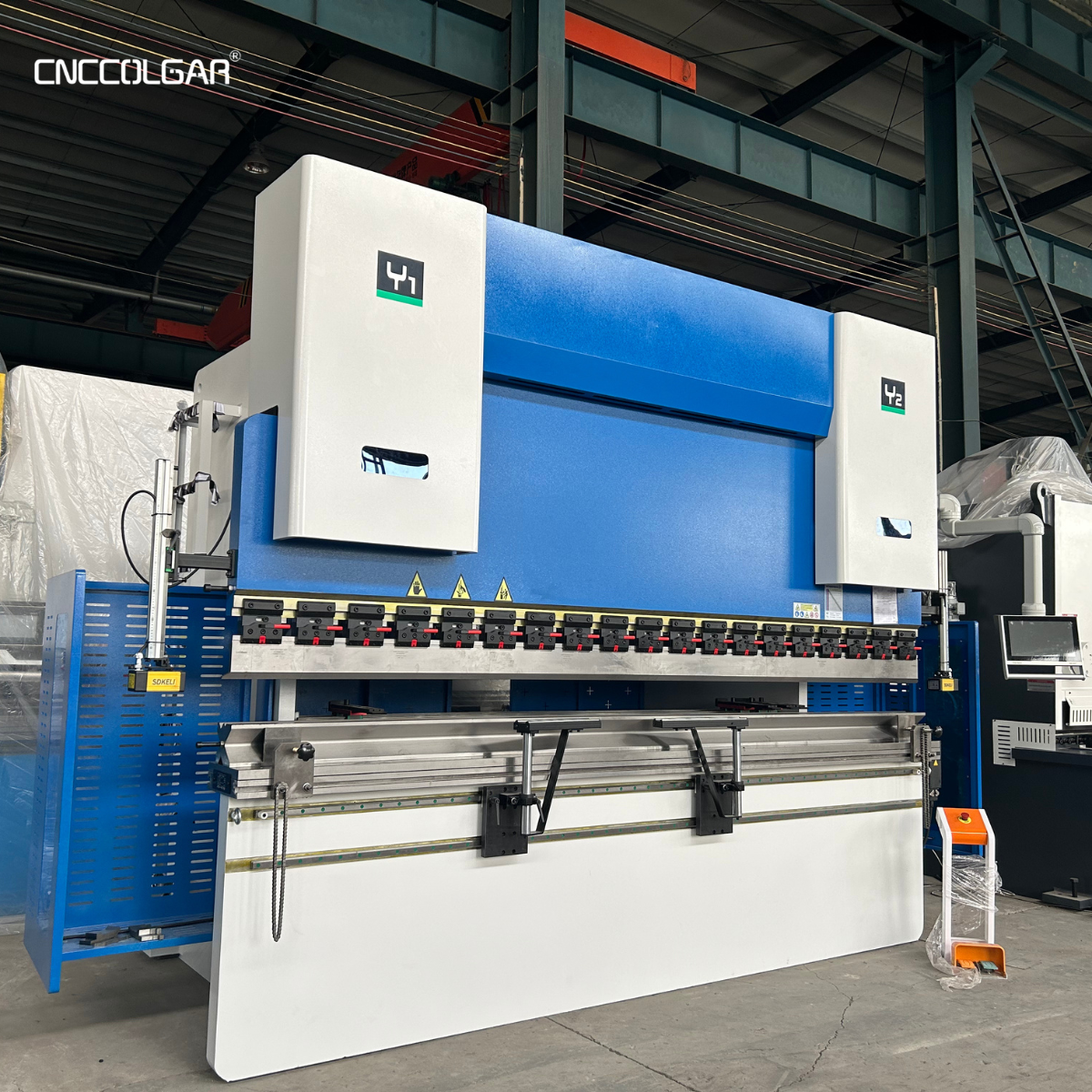
Heavy fabrication involves more than generating enough force to bend a plate. Long edges need a consistent angle, successive flanges need defined locations and different components need usable tooling arrangements.
A CNC press brake brings these requirements into one forming operation, although its benefits depend on the workpiece and installed configuration. Five capabilities explain its value: a usable load range, stable support under force, compensation along the bend, repeatable positioning and adaptation to different component geometries, each addressing a different production requirement.
- Capacity for Substantial Plates and Long Bends
A hydraulic drive supplies the force needed to make the punch deform the plate against the die. Within its rated operating conditions, a hydraulic press brake machine can form substantial sections without requiring the geometry to be assembled entirely from separate flat pieces. A bent channel, for example, can incorporate a web and flanges in one component, leaving a different joining task from a fabricated collection of plates.
The machine’s working length sets the maximum length of a straight bend it can accommodate. Force and length remain connected to material strength, thickness, die opening and the forming method; neither a long table nor a large force rating independently establishes every bending capability. The benefit is access to a defined family of heavy components whose bends fall within the machine and tooling limits.
- Stable Support for the Forming References
The tooling needs a supporting structure that keeps its upper and lower references in a controlled relationship while force is applied. A rigid frame on a CNC press brake limits the movement that can disturb that relationship. This matters when a flange becomes a locating surface for later assembly: its position and angle affect how the component sits against adjoining parts, rather than merely how it looks after bending.
Stable support also gives process adjustments a more consistent mechanical foundation. Changing the intended penetration is easier to interpret when unrelated movement in the supporting structure is limited.
The outcome still depends on correctly seated tools, suitable workpiece support and the material response. Frame rigidity contributes to a controlled forming condition without replacing those other requirements or implying that the structure remains perfectly undeformed.
- Compensation for Angle Variation Along Long Edges
Lengthwise consistency is a separate concern from the overall angle of a bend. Elastic deflection can leave the middle of a long component at a different angle from its ends. Crowning on a hydraulic press brake machine adjusts the longitudinal tool relationship to address that pattern. Lowering the ram uniformly changes penetration across the bend, while compensation addresses a difference distributed along its length.
Compensation forms part of the WE67K design described by Colgar for its bending equipment. Matching the correction to the bending conditions can bring angles along a long edge closer to the specified bend angle.
That can matter where a flange must meet another long surface during assembly. Measurements at several positions distinguish a lengthwise deviation from an overall angle error, so the correction corresponds to the observed pattern.
- Repeatable Positioning Across a Bend Sequence
Successive flanges often require different distances between the plate edge and the bend line. Programmed positioning on a CNC press brake retains the supported movements associated with that sequence, reducing the need to establish every position independently for each component. The immediate benefit concerns repeated locating references: a batch can follow an established sequence instead of relying entirely on a fresh manual setting at every bend.
Position feedback provides a means of relating an axis command to measured movement. Colgar describes grating rulers within its press brake range, which also distinguishes closed-loop servo arrangements from economical torsion-bar machines.
The available feedback and synchronization depend on the configuration. Repetition consequently rests on the positioning arrangement fitted to the machine, together with the way the workpiece contacts its locating references.
A reusable sequence also needs the corresponding tools and material definition. A different die opening or material batch can require a change to the penetration setting even when the flange dimensions remain unchanged. Recalling positions preserves established movements; confirming the forming result accounts for conditions that a stored position alone cannot describe.
- Adaptation to Different Component Families
Tool choice and bend order determine whether the next fold is reachable. A gooseneck punch can provide clearance around an existing flange on a deep channel. The setup still needs a clearance check through the full bend, using the part drawing and the proposed tool profile.
As a component develops flanges, the flat surfaces available for supporting and gripping it change. The production team should check how the part will be carried and turned between strokes. Those handling and clearance requirements give buyers a basis for comparing Colgar configurations and specifying compatible tooling.
For heavy fabrication, a hydraulic press brake should have sufficient rated force and working length, stable tool support and a way to control angle variation along long bends. Repeatable positioning and suitable tooling make those capabilities useful across different parts.
Before a purchase, a trial with a representative heavy component can confirm the bend angle along the part, the flange dimensions and the clearance needed between bends.
