Combining an entire refrigeration system in one cabinet removes some installation complexity, but it also brings the compressor closer to the people using the cabin. That exchange matters on a boat where a sleeping berth, storage compartment and service opening may occupy the same square metre.
The compact-machine decision is less a contest between convenient products than a question of which compromises the hull can accommodate. Space saved in one part of the vessel often has to be given back elsewhere.
What a Single Cabinet Actually Changes
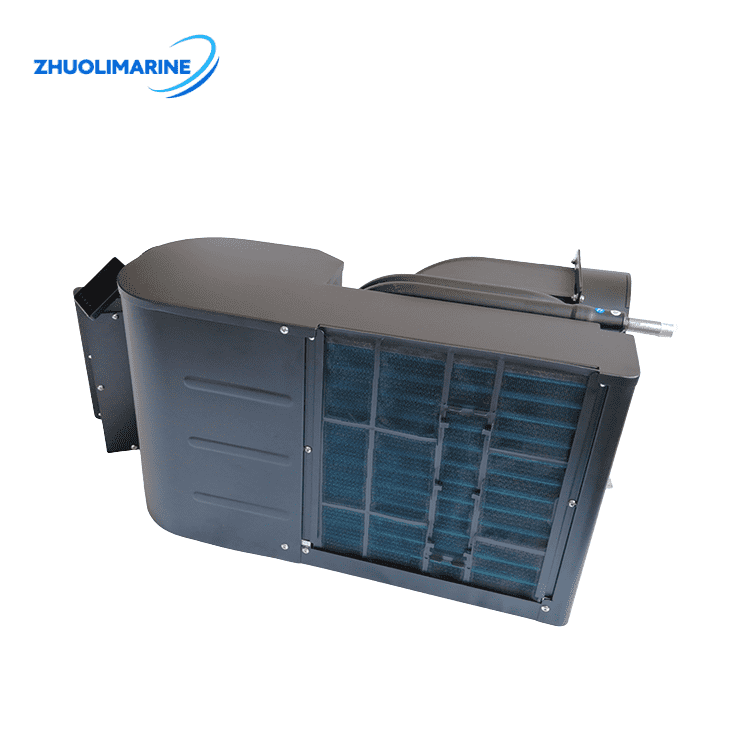
The word self-contained describes the refrigeration layout. The compressor, evaporator, condenser and blower share a housing instead of being divided between a remote condensing unit and an indoor air handler.
For a single cabin, self contained boat air conditioners reduce the need to route connecting refrigerant lines between separate machinery locations. A split arrangement, by contrast, can place its compressor and condenser away from an occupied space.
Fewer separate refrigeration components do not make the vessel installation self-sufficient. The condenser still needs a dependable heat-rejection circuit, the blower needs a supply and return air path, and the unit needs electrical protection.
A smaller machinery footprint can therefore coexist with a demanding plumbing layout. Whether integration is useful depends on the shape of the available compartment, not merely on its total volume.
The Acoustic Cost of Putting Machinery Nearby
A berth adjacent to a compressor experiences more than the sound reported on a product sheet. Cabinet resonance, the stiffness of surrounding panels and how the blower is aimed all influence what occupants hear.
A split design can move some mechanical sound farther away, although its additional components and interconnecting lines introduce other installation obligations. The quieter option cannot be established from enclosure dimensions alone.
The published specifications for the MAR-12V/09BP 9,000 BTU DC model list noise levels of 42/52 dB and airflow of 500 m³/h. These figures are useful for reviewing the specified operating conditions but do not predict the sound level or airflow in every installation. Those numbers are useful for comparing specified operating conditions; they are not a prediction of sound at a particular pillow.
Mounting location, airflow restrictions and the surrounding joinery still affect the result. The MAR-12V/09BP has a specified heating capacity of 10,450 BTU, making its heating performance another factor to consider when planning cabin use during cooler periods.
Acoustic assessment is most useful after berth cushions, locker covers and surrounding panels are in place. A narrow return grille can add airflow noise, while rigid joinery may transmit vibration to a nearby sleeping surface.
Isolation details and flexible connections can affect that transmission, but their suitability depends on the actual installation instructions. None of these measures substitutes for considering the basic proximity of compressor and occupants at the layout stage.
Service Clearance Is Part of the Footprint
A cabinet that slides into a locker may be impossible to maintain once hoses and wiring have been connected. Service access means a technician can reach the filter, inspect fittings and remove components without dismantling a berth platform. Seawater intake and discharge routing, a safe condensate path and access to protective devices all deserve space on the installation drawing.
For self contained boat air conditioners, gathering the refrigeration components in one location can simplify fault inspection. It also concentrates maintenance tasks in a confined place.
The MAR-12V/09BP measures 480 × 330 × 335 mm and weighs 20 kg net. The currently listed MAR-24V/12BP and MAR-48V/16BP each measure 590 × 345 × 345 mm, with net weights of 25 kg and 26 kg, respectively. These figures describe the equipment bodies rather than the full service envelope, which should also be included in installation planning.
A dimensioned service drawing should show the side from which the filter is reached, the hose-connection area and a possible route for removing the entire cabinet. Otherwise, even a minor inspection may require taking apart fixed furniture.
The drawing can also expose conflicts with existing batteries, water lines or storage areas before installation begins. These competing uses of a small compartment are often more restrictive than the published cabinet size.
Power and Seawater Still Set the Boundaries
An integrated cooling machine is not equivalent to a household appliance that can be plugged into any available outlet. Across the three 9,000 BTU DC versions, rated current drops from 55 A on the MAR-12V/09BP to 32 A on the MAR-24V/09BP and 16 A on the MAR-48V/09BP.
The 12V model has 660 W rated input and 720 W maximum input; both higher-voltage versions are rated at 750 W with 950 W maximum input. All three specify 720 L/h seawater flow.
These figures put a useful limit on casual claims about compactness. In self contained boat air conditioners, adequate DC supply capacity, protected wiring and an appropriately designed seawater circuit remain essential even when no remote condenser is fitted.
Wi-Fi adjustment and variable-frequency compressor control are listed for the ZhuoliMarine DC models; neither changes the access needed for hose inspection and filter replacement.
A compact machinery space rewards careful compromise rather than the smallest possible enclosure. ZhuoliMarine offers integrated marine cooling and heating units, installation instructions, spare-part access and remote technical support backed by a one-year remote warranty.
A dimensioned drawing still needs to account for filter removal, hose fittings and protective devices. The installer can use the service-access sketch to verify those clearances.
