Gear accuracy is a critical factor that determines the performance, reliability, and service life of industrial transmission systems. Different applications require different levels of precision, making gear accuracy grades an essential reference for manufacturers when selecting processing methods and equipment.
From automotive components to robotics and automation systems, accurate gear production helps reduce noise, vibration, and energy loss.
For companies involved in advanced gear manufacturing, choosing suitable machining equipment is equally important as understanding accuracy standards. A high-performance CNC gear machine can provide the precision and consistency required for producing complex gears.
ZDCY, a CNC gear machine manufacturer specializing in the research, development, production, and sales of high-end CNC gear processing machines, provides solutions designed to support modern industrial gear production needs.
What Are Gear Accuracy Grades in Industrial Manufacturing?
Gear accuracy grades are classification systems used to evaluate the precision of manufactured gears. These grades typically consider multiple factors, including tooth profile deviation, pitch accuracy, tooth alignment, and overall dimensional consistency. A higher accuracy grade indicates tighter manufacturing tolerances and better gear performance.
In industrial applications, gear accuracy directly influences operating efficiency. Low-precision gears may create excessive vibration, noise, and uneven load distribution during operation. For high-speed machinery or precision equipment, these issues can shorten component lifespan and increase maintenance requirements.
Manufacturers usually select gear accuracy levels based on the working environment, load requirements, rotation speed, and application purpose. For example, standard industrial equipment may use moderate accuracy grades, while aerospace, robotics, and precision automation systems often require much higher precision levels.
How Are Gear Accuracy Grades Classified?
Different international standards define gear accuracy grades, with DIN, ISO, and AGMA systems being widely used in industrial manufacturing. These standards provide guidelines for measuring gear quality and help manufacturers maintain consistent production requirements.
DIN standards, commonly applied in European industrial applications, classify gear precision through numbered grades. Lower numbers generally represent higher precision. For example, a gear reaching DIN4 level represents a very high degree of manufacturing accuracy and is suitable for demanding applications requiring smooth operation and precise transmission.
The selection of accuracy grades depends on the balance between performance requirements and production costs. Producing higher-grade gears often requires advanced machining technology, improved inspection processes, and more precise control systems. Therefore, manufacturers need to evaluate application requirements carefully before determining the appropriate accuracy level.
Why Does Gear Accuracy Matter for Industrial Equipment?
Gear accuracy plays a major role in improving mechanical efficiency and operational stability. Precise gear teeth can ensure better contact between mating gears, allowing power to transfer more smoothly with reduced friction and energy loss.
For industries such as robotics, UAVs, and automation, even small gear deviations can affect positioning accuracy and system response. These industries require gears that can operate under strict precision conditions, making high-accuracy machining capabilities increasingly important.
The use of an advanced CNC gear machine allows manufacturers to achieve consistent gear quality through automated control and precise machining processes. Compared with traditional equipment, modern CNC systems can improve repeatability, reduce human errors, and support the production of complex gear structures.
How Does a CNC Gear Machine Improve Gear Processing Accuracy?
A CNC gear machine integrates computer numerical control technology with specialized gear processing functions to achieve efficient and accurate manufacturing. By controlling multiple machining axes simultaneously, these machines can produce complex gear geometries while maintaining strict tolerance requirements.
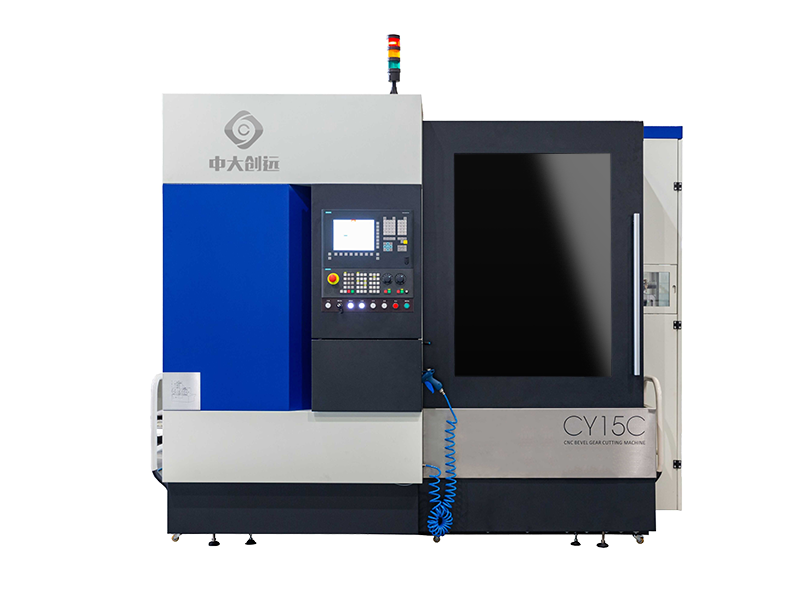
ZDCY’s CY15C CNC Spiral Bevel Gear Cutting Machine is designed for high-precision small-module spiral bevel gear processing. As a six-axis six-linkage dry-cutting full-function machine tool, CY15C can machine various spiral bevel gears and hypoid gears with extended epicycloid equal-height teeth and circular arc shrinkage teeth.
The machine is mainly applied to small-module spiral bevel gear milling in industries such as small reducers, power tools, UAVs, robots, CNC machine tools, and automation lines. Its gear-grinding precision can reach DIN4 level, while tooth-surface roughness can achieve Ra1.6, supporting applications that require high accuracy and smooth transmission performance.
Equipped with spiral bevel gear HCS processing control software integrated into the SIMUMERIK ONE CNC system, CY15C provides advanced control capabilities for complex gear machining. This integration helps manufacturers improve processing efficiency while maintaining stable product quality.
What Factors Should Manufacturers Consider When Selecting Gear Processing Equipment?
Selecting suitable gear processing equipment requires consideration of several factors, including gear type, module size, accuracy requirements, production volume, and application environment. A machine designed for precision spiral bevel gears may have different capabilities from equipment used for standard cylindrical gears.
Manufacturers should also evaluate machining flexibility. Equipment that supports multiple gear structures can provide greater production adaptability and reduce the need for multiple specialized machines.
Automation features are another important consideration. Modern CNC gear machines with intelligent control systems can simplify operation, improve machining consistency, and help manufacturers respond to increasingly demanding industrial requirements.
Building Higher-Precision Gear Manufacturing Capabilities
As industrial equipment continues to move toward higher efficiency and intelligence, the demand for precise gear components is increasing. Gear accuracy grades provide manufacturers with a clear measurement standard, while advanced machining equipment enables them to achieve these requirements in practical production.
ZDCY’s high-end CNC gear processing machines, including the CY15C CNC Spiral Bevel Gear Cutting Machine, demonstrate how advanced CNC technology can support precision gear manufacturing. By combining accurate machining performance with intelligent control systems, these solutions help industries produce reliable gears for modern mechanical applications.
Understanding gear accuracy grades and selecting the right CNC gear machine are essential steps for manufacturers seeking stable quality, improved efficiency, and long-term competitiveness in the evolving industrial market.
