When designers develop winter apparel and other thermal products, warmth is only part of the equation. Weight, thickness, flexibility, moisture behavior, and freedom of movement can all affect the final product. Down has long been valued for its excellent warmth-to-weight ratio, but it generally depends on loft to create an insulating layer. For applications where available space is extremely limited, manufacturers are increasingly looking at alternative forms of lightweight insulation.
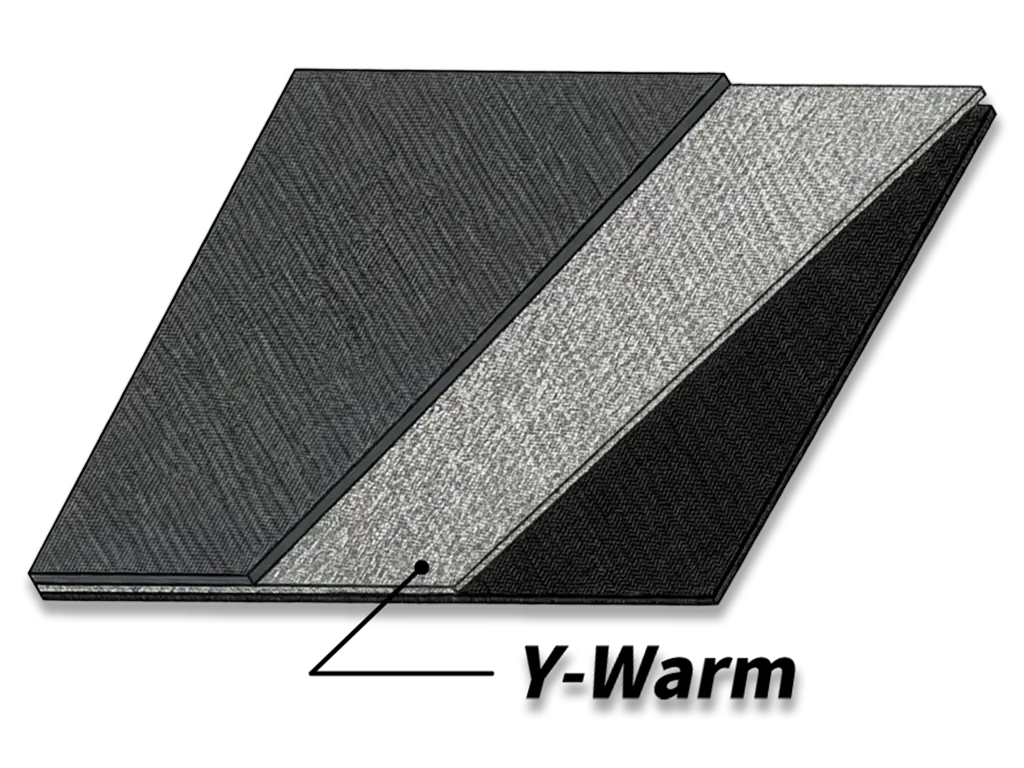
Y-Warm takes a different approach. Rather than depending primarily on loft, it uses an engineered closed-cell structure to slow heat transfer within an ultra-thin material. This difference makes the comparison between Y-Warm and down less about identifying one universally superior material and more about understanding which insulation structure fits a particular product.
How Do Down and Lightweight Insulation Work Differently?
Down provides insulation through its three-dimensional cluster structure. When properly lofted, down traps a large amount of still air, which helps reduce heat transfer. Its low weight and high warmth-to-weight ratio have made high-quality down particularly attractive for winter clothing and outdoor equipment.
However, loft is also an important part of how down works. A garment needs sufficient space for the down clusters to expand and maintain that insulating air volume. Compression can reduce loft, while moisture can cause down clusters to clump and reduce their insulating effectiveness.
Y-Warm approaches insulation from a different direction. Its internal structure contains microscopic closed cells with cell walls approximately 20–280 nanometers thick and pore sizes of approximately 30–190 micrometers. The company reports a closed-cell ratio above 95% and effective porosity above 96%. This structure is designed to limit internal gas movement and reduce heat transfer without requiring substantial loft.
Why Does Low-Bulk Design Matter for Lightweight Insulation?
Low bulk can be particularly valuable when designers need thermal performance without changing the silhouette, mobility, or packaging characteristics of a finished product.
A conventional down-filled garment needs sufficient volume for the insulation to loft. By comparison, Y-Warm’s YW-01 is approximately 0.7 mm thick. The company reports that a single layer can provide approximately 10°C of thermal insulation under specified test conditions. Importantly, this figure represents a comparative test result rather than a universal temperature increase in every finished product.
This ultra-thin format can be useful for products in which millimeters matter. For example, Y-Warm’s apparel application guidance shows the material placed between the outer fabric and lining. One lightweight jacket application uses a single 0.7 mm layer of YW-01 and is intended for environments above approximately 8 °C.
For manufacturers, the benefit is not simply making insulation thinner. It is creating more flexibility in product construction. A low-profile insulation layer can help designers explore slimmer garments, compact thermal products, or hybrid constructions where Y-Warm is combined with other insulation materials.
Y-Warm vs. Down: Which Is Better for Low-Bulk Applications?
The answer depends on the product requirements. Down remains an effective choice when high loft, low weight, compressibility, and traditional insulation construction are desirable. Y-Warm becomes interesting when designers place greater emphasis on lightweight insulation with minimal thickness.
Thermal conductivity provides one useful way to understand the difference. Y-Warm reports thermal conductivity of approximately 0.020 W/(m·K), although the company notes that measurements can vary according to test method, sample configuration, and testing conditions.
Moisture behavior is another consideration. Down can lose loft when wet and generally requires time to dry and recover. Y-Warm incorporates hydrophilic functional groups that the company says facilitate moisture-vapor transport through the material. This does not mean finished garments will automatically have the same moisture performance, because fabric selection, construction, lamination, and garment design also influence the final system.
Y-Warm also has its own design considerations. The company describes it as flexible but firmer in feel than soft insulation such as down. It has limited stretch in the warp and weft directions and is therefore better suited to woven outerwear than highly stretchable fabrics.
What Should Manufacturers Evaluate Before Choosing an Insulation Material?
The best material choice should be based on the complete product system rather than one performance number. Manufacturers should consider target warmth, available thickness, garment construction, expected compression, moisture exposure, flexibility, washing requirements, and the intended operating environment.
For down-based products, maintaining loft and managing moisture are important considerations. For Y-Warm-based products, processing and construction also require attention. The company recommends appropriate handling of the material and notes that dense quilting can increase stiffness, while full-coverage adhesive lamination can affect moisture-vapor permeability.
Testing the finished construction is therefore essential. A material’s nominal thermal conductivity or thickness cannot, by itself, predict the exact warmth experienced by the wearer. The outer fabric, lining, seams, compression, airflow, humidity, and construction method all contribute to final performance.
A Different Route to Low-Bulk Thermal Design
Y-Warm develops advanced metamaterial-based insulation focused on combining thermal performance with a thin, lightweight, flexible structure. Their Y-Warm material is approximately 0.7 mm thick in the YW-01 specification and is designed for applications including apparel, footwear, and other products where insulation space is limited.
For brands and manufacturers developing low-bulk thermal products, comparing Y-Warm with down can help clarify which insulation architecture best matches the intended design. To explore Y-Warm as a lightweight insulation option for a specific product, contact Y-Warm Technologies for technical information and application guidance.
