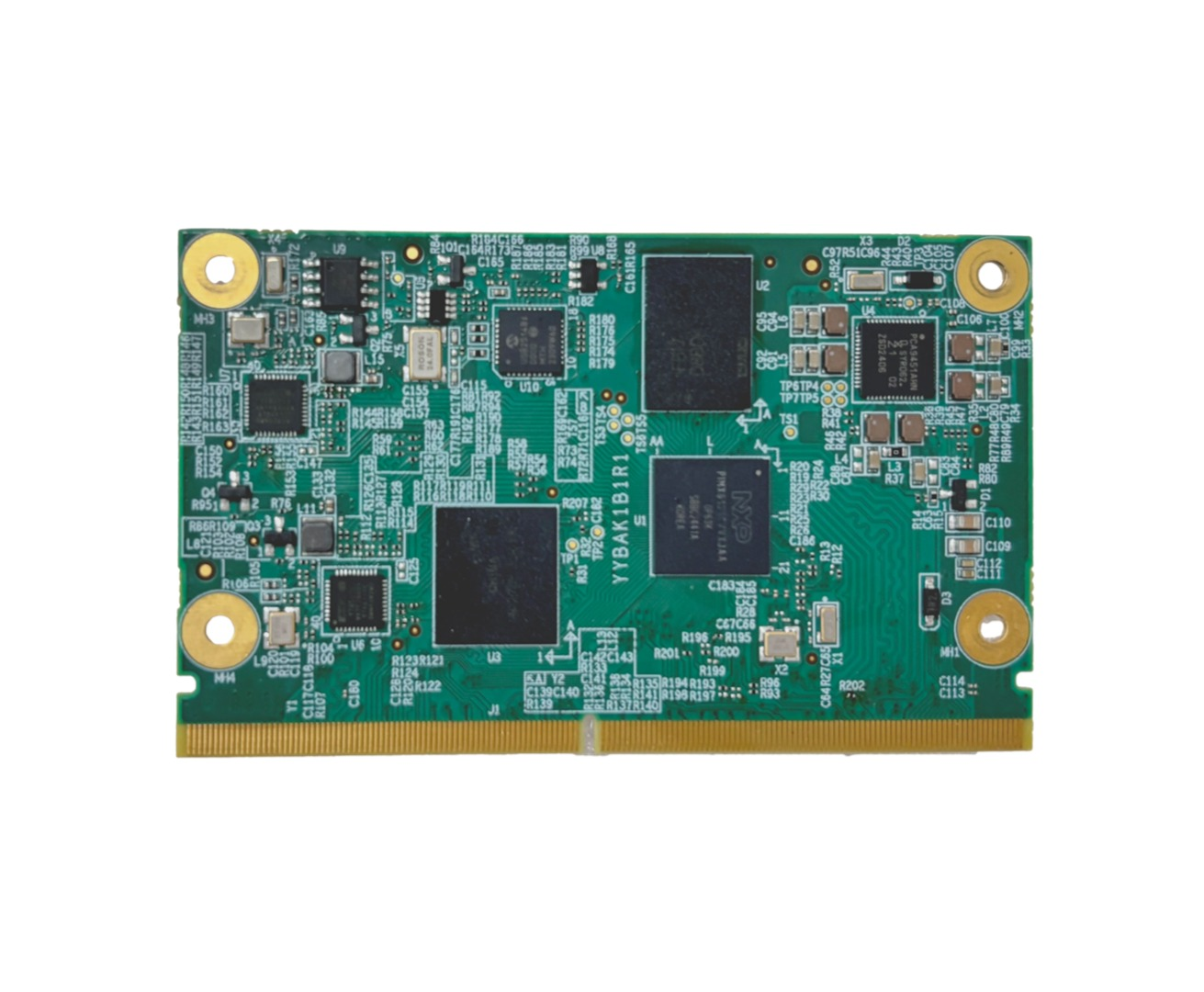
Every industrial product team eventually runs into the same wall: the processor that made sense two years ago is now hard to source, the carrier board needs a redesign for the next customer request, and the engineering backlog keeps growing faster than the roadmap. These are not isolated frustrations. They are symptoms of a hardware architecture problem, and it is exactly the problem a System on Module was designed to solve.
The Redesign Trap That Slows Product Development
Building custom hardware from the ground up for every product variant is expensive and slow. Each new feature request, whether it is an added sensor interface or a different display, can trigger a full board respin, complete with new certifications and validation cycles. For system integrators managing several customer projects at once, this cycle consumes engineering hours that should go toward differentiation instead of repetition.
A System on Module separates the processor, memory, and core logic from the application-specific I/O. Because the carrier board handles the interfaces unique to each product, engineering teams can reuse the same compute core across multiple product lines. This alone removes a large share of the redesign burden that traditionally slows down embedded product development.
Component Obsolescence and the Risk It Creates
Processor obsolescence is one of the most disruptive problems in industrial hardware design. A component that disappears from the market mid-production run can force a redesign, delay shipments, and strain customer relationships. This risk is especially high for consumer-grade chipsets, which are rarely supported for more than a few years.
System on Module architecture reduces this exposure by isolating the processor on a replaceable module. When a chipset nears end-of-life, a pin-compatible successor module can often be swapped in without touching the carrier board design. This gives manufacturers a practical path to extend product life well beyond the lifespan of any single processor generation.
Meeting Harsh Environments Without Starting Over
Industrial deployments rarely happen in climate-controlled rooms. Equipment installed in outdoor cabinets, warehouse floors, or rail systems must tolerate vibration, dust, humidity, and wide temperature swings. Designing a custom board that meets these conditions from scratch requires extensive thermal and mechanical validation.
A properly engineered System on Module comes pre-validated for these conditions, so integrators inherit tested reliability rather than building it themselves. This shortens the qualification process considerably and gives product teams confidence that the compute core will perform consistently once deployed in the field.
Scaling Across Product Lines Without Fragmenting Engineering Resources
Manufacturers serving multiple markets, such as medical equipment and smart retail, often need different performance tiers from the same underlying platform. Maintaining separate hardware designs for each tier multiplies engineering overhead and complicates long-term support.
Because SoM designs share a common form factor and interface standard, a single carrier board can often accept modules with different processing capabilities. This allows manufacturers to offer entry-level and high-performance variants of the same product without duplicating the surrounding design work, keeping engineering resources focused on differentiation rather than repetition.
How Vantron’s System-on-Module Lineup Addresses These Challenges
Vantron builds its System-on-Module portfolio specifically around these industrial pain points, offering SMARC, Q-Seven, COM Express, and Open Standard Module options across ARM and x86 platforms. Each module is designed for long-term deployment rather than short product cycles.
For applications needing efficient, low-power processing, the VT-SBC-SMARC-IMX91 pairs an NXP i.MX9131 Arm Cortex-A55 processor running up to 1.4 GHz with 512MB of LPDDR4 memory, expandable to 8GB, and 16GB of eMMC 5.1 storage. It includes two gigabit Ethernet ports, dual CAN interfaces, 40 GPIO pins, and four ADC inputs, and it operates across a -40°C to +85°C range while drawing a maximum of 6W.
This combination makes the module well suited to industrial automation and smart home gateways, where compact size and low power draw matter as much as connectivity.Its UART, I²C, SDIO, CAN, and GPIO interfaces provide flexible peripheral connectivity, although external transceivers or bridge devices may still be required.
For workloads requiring higher performance, the VT-SBC-SMARC-IMX95 integrates a hexa-core Arm Cortex-A55 processor alongside dedicated Cortex-M7 and Cortex-M33 microcontrollers, supported by 8GB of LPDDR4x memory and an onboard NPU delivering up to 2 TOPS of AI acceleration. Networking options extend to dual gigabit Ethernet and a 10 gigabit Ethernet port, alongside Wi-Fi 5 and Bluetooth 5.0.
Display support on the VT-SBC-SMARC-IMX95 spans HDMI, MIPI DSI, and LVDS, with 4K at 60Hz H.265 and H.264 encoding and decoding built in. This makes the module a strong fit for machine vision, medical imaging, and interactive kiosk applications that demand both AI inference and high-resolution video handling on a single compute core.
Both modules share the SMARC 2.1 form factor, letting integrators scale performance across a product line without redesigning the surrounding carrier board. Vantron also offers a matching SMARC carrier board reference design, giving customers a validated starting point that shortens development further instead of requiring a fully custom layout from the first prototype.
Supporting the Design-In Process, Not Just the Hardware
Solving hardware problems is only part of the equation. Vantron also provides driver packages, board support packages, and FAE assistance throughout the integration process, which shortens development timelines for teams unfamiliar with a new processor family. Long-lifecycle component sourcing and stable bills of materials further protect customers from the supply disruptions that often accompany component transitions.
For equipment manufacturers, system integrators, and solution providers, the value of a System on Module is not simply the hardware itself. It is the reduction in redesign risk, the extended product lifespan, and the ability to scale a single platform across multiple applications with confidence.
As industrial products are expected to stay in service longer while adapting to new features and standards, this modular approach has become less of an engineering convenience and more of a business necessity. Partnering with a manufacturer that understands both the technical and commercial pressures behind that shift makes the difference between a product that merely launches and one that remains supportable for years to come.
