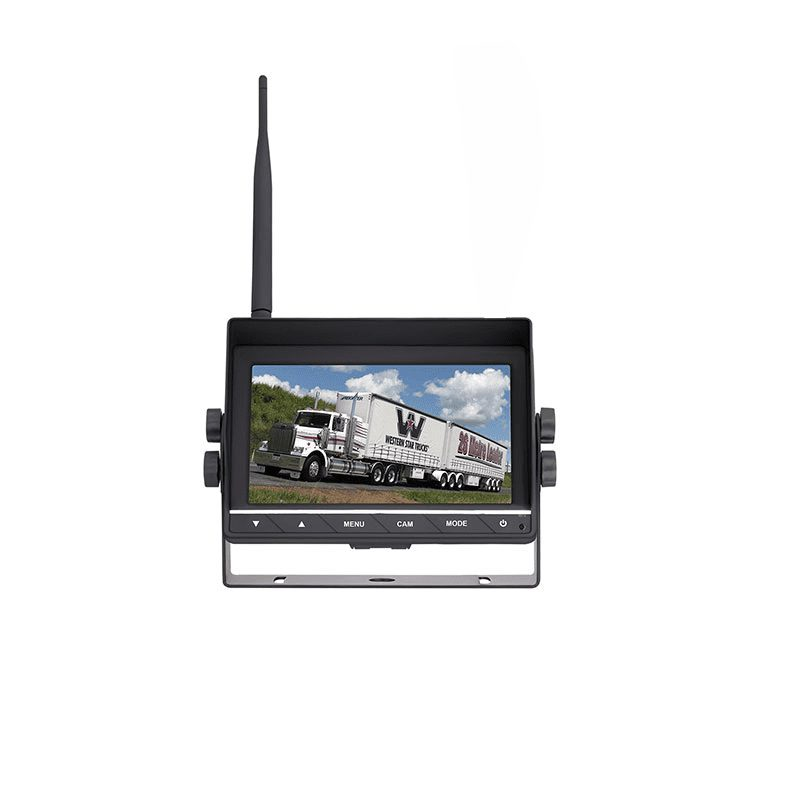
In the world of fleet management, the term “backup camera” is often used broadly, yet the performance requirements for an industrial forklift and a standard passenger vehicle are worlds apart. While both systems aim to provide visibility, the environmental stressors and functional goals of a forklift backup camera system require a level of engineering far beyond that of a typical wireless car camera system. For experienced industrial clients, recognizing these distinctions is essential for ensuring long-term safety and hardware reliability.
The Foundation: Understanding the Industrial Environment
Industrial workplaces—ranging from bustling logistics centers to heavy manufacturing plants—present a unique set of challenges. Unlike public roads, these environments involve constant 360-degree movement, narrow aisles, and high-frequency reversing maneuvers. Standard automotive cameras are designed for occasional use during parking. In contrast, a forklift system is a primary operational tool used continuously throughout a multi-shift workday.
The primary difference lies in the “duty cycle” of the equipment. Automotive systems are often integrated into the vehicle’s infotainment, activated only when the gear is in reverse. However, in a warehouse, an operator may require constant monitoring of the forks, the load, and the rear path simultaneously to prevent collisions with racking or personnel. This necessitates a robust, dedicated monitor and a camera system that can maintain high-definition clarity under constant vibration and shifting light conditions.
Technical Superiority of the Luview Industrial System
By analyzing the specifications of the Luview wireless forklift safety solutions, we can identify the specific advantages that elevate these systems above consumer-grade automotive technology. Based on the technical requirements of the JY-M745W monitor and JY-F5 camera, the following features define their industrial efficacy.
1. Ruggedized Durability and Environmental Ratings
Automotive cameras are generally protected by the car’s bumper or chassis and rarely face extreme conditions beyond rain or road salt. A professional forklift backup camera system must withstand much more. The Luview JY-F5 camera features an IP68 waterproof design, ensuring it is completely sealed against fine dust and high-pressure water ingress.
The operating temperature ranges are equally critical. According to the system specifications, the Luview camera operates reliably from -20°C to +60°C, while the monitor remains functional from -20°C to +60°C. This ensures the system does not fail when moving between a sub-zero cold storage unit and a non-air-conditioned loading dock—a scenario that would cause a standard wireless car camera system to suffer from internal condensation or component failure.
2. Signal Stability and Transmission Distance
In a warehouse filled with dense metal racking and high-frequency electronic signals, wireless interference is a common obstacle. While a car camera only needs to transmit over a few meters, a forklift system requires superior signal penetration. Luview’s digital wireless technology provides a maximum transmission distance of up to 60 meters. This high-power transmission ensures that the video feed remains stable and latency-free, even when the camera is mounted on the far end of a reach truck’s mast.
3. Specialized Positioning and Visual Aids
A standard car camera provides a simple wide-angle view for parking. However, the Luview system is equipped with a laser positioning function. On the monitor, guidelines can be set up to ensure accurate positioning for fork lifting. This allows experienced operators to align forks with precision at height, preventing the micro-collisions that lead to product damage or racking failure. Furthermore, the monitor supports an “automatic ruler switch,” allowing the screen to display different scale rulers depending on the operational context—a feature completely absent in automotive electronics.
4. Efficient Power and Installation Flexibility
The industrial workflow demands “easy installation” to minimize machine downtime. Luview addresses this with a magnetic mounting structure for the camera, allowing for setup in minutes without complex wiring. Unlike the 12V-only systems found in cars, the Luview monitor supports a wide power supply range of 12/24V, making it compatible with a variety of electric and internal combustion forklifts. Additionally, the camera boasts an exceptionally low power consumption of 1.85W and includes an automatic shutdown feature to conserve energy during idle periods.
Why Experience Matters in Procurement
For a safety officer, the “best” system is the one that remains operational under pressure. Consumer-grade hardware often fails due to the constant vibration of a forklift’s chassis. Luview’s systems are built with high-performance components designed to dampen vibration and maintain a clear 7-inch digital LCD image regardless of the floor surface.
Moreover, the system’s ability to support up to four high-definition cameras simultaneously allows for a complete 360-degree view. While a wireless car camera system typically focuses only on the rear, the forklift backup camera system from Luview empowers operators to monitor all four sides of the vehicle, effectively eliminating the blind spots that lead to the most severe workplace accidents.
Conclusion: Investing in Purpose-Built Safety
When comparing a forklift backup camera system to an automotive one, the differences are found in the details: the IP68 rating, the 50-meter wireless range, and the laser-guided precision. While automotive cameras are excellent for the road, they lack the structural and electronic fortitude required for the “zero-harm” goals of a modern warehouse.
By choosing Luview, businesses are not just buying a camera; they are investing in a specialized industrial tool. With features like the magnetic mounting, wide temperature tolerance, and low power consumption, these systems provide a reliable safety envelope that consumer hardware simply cannot match. For the professional fleet, the choice is clear: specialized equipment is the only way to ensure both operator confidence and long-term operational efficiency.
