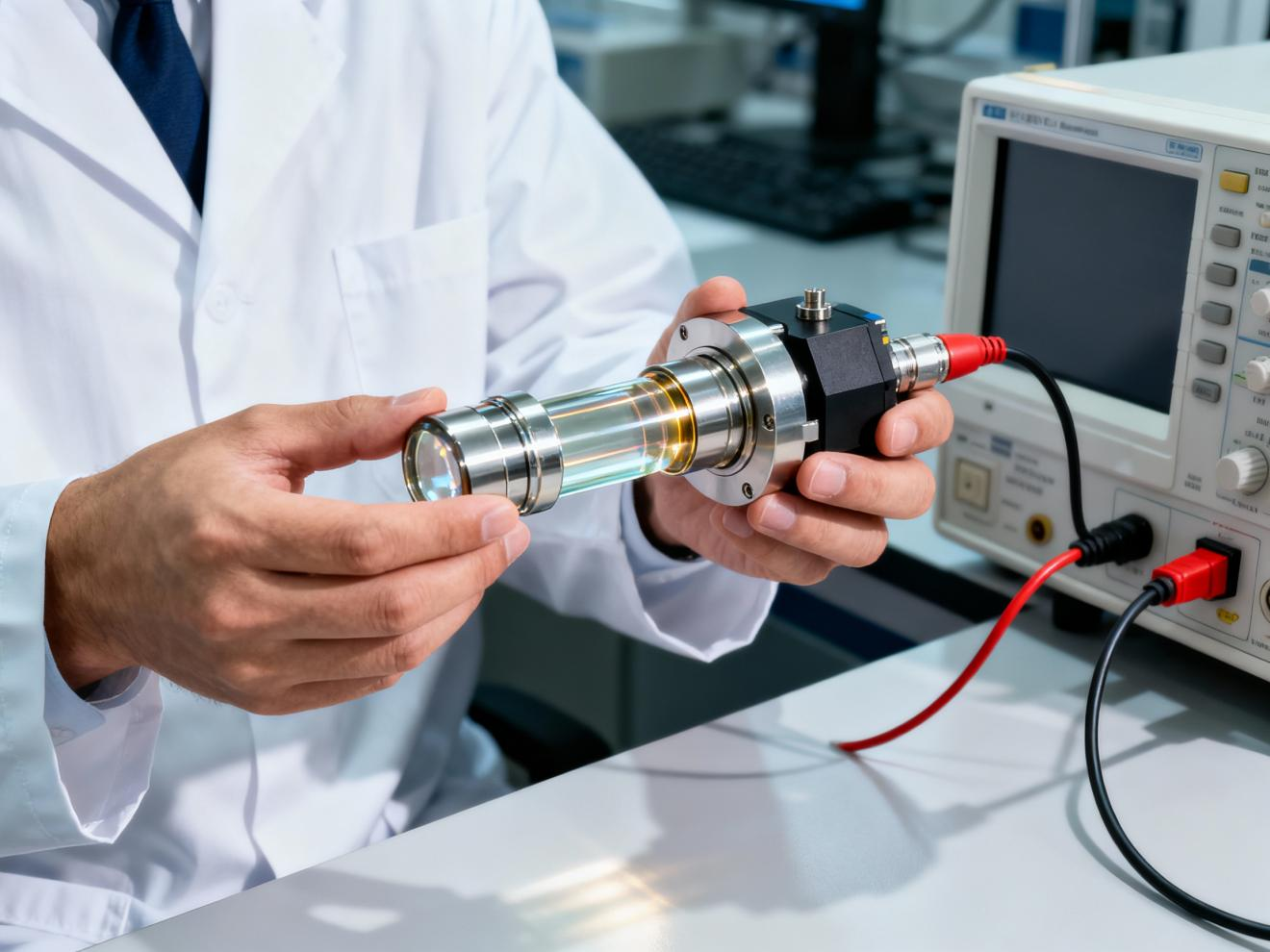
In the field of optical component manufacturing and testing, the selection of testing equipment directly impacts a company’s production costs, testing efficiency, and market competitiveness. With the rapid expansion of the commercial optical component market, controlling costs while maintaining testing accuracy has become a core concern for many manufacturers. This article will provide an in-depth comparison of adjustable power supplies (VPS) and dedicated testing equipment, analyzing the core advantages of the former in cost optimization, and offering professional guidance for selecting optical testing solutions based on industry case studies.
The Cost Dilemma: The Hidden Burden of Dedicated Test Equipment
In traditional optical component testing, dedicated test equipment was once the mainstream choice in the industry. Its customized design for specific transceiver form factors was considered the optimal solution for ensuring testing accuracy. However, with the rapid iteration of technical standards (such as the upgrade from 10G to 40G and 100G), the limitations of dedicated test equipment have become increasingly apparent.
The core pain points of dedicated test equipment lie in proprietary lock-in and wasted investment due to obsolescence. These devices are usually tailored to specific protocols or component form factors. When industry standards are updated, the old equipment often cannot adapt to the new testing requirements and must be replaced, resulting in significant capital waste. Furthermore, dedicated equipment suffers from severe vendor lock-in issues; its supporting components can often only be purchased from a single source, leading to high procurement costs and the risk of supply chain disruptions.
The experience of a medium-sized optical component manufacturer in California is quite representative: during a protocol upgrade, the company initially planned to purchase a new dedicated analyzer with a budget of $150,000. Ultimately, by reprogramming their existing adjustable power supply, they successfully adapted to the new testing requirements, directly saving the entire hardware procurement cost. This case fully illustrates the cost disadvantages of traditional dedicated equipment.
The Path to Breakthrough: The Three Core Advantages of Programmable Power Supplies
Compared to dedicated test equipment, programmable power supplies are becoming the mainstream choice in the commercial optical testing field due to their combined advantages in cost, accuracy, and flexibility. Data shows that programmable power supplies have 40% lower capital expenditure than dedicated test equipment, while maintaining a voltage setting accuracy of 0.05%, fully meeting the testing needs of most commercial optical components.
1. Cost-Effectiveness: Breaking Free from Iteration and Vendor Lock-in
Programmable power supplies use software-defined voltage profiles, allowing them to simulate various operating conditions such as undervoltage lockout (UVLO) and surge testing on a single desktop device, eliminating the need to purchase multiple devices for different testing requirements. Their flexible programming capabilities allow them to easily adapt to technological standard iterations, significantly extending equipment lifespan and avoiding the waste caused by dedicated equipment becoming obsolete due to standard updates.
At the supply chain level, programmable power supplies overcome the vendor lock-in dilemma of dedicated equipment. Companies do not need to rely on proprietary components from a single supplier, allowing for diversified procurement to reduce costs and mitigate supply chain disruption risks. According to industry statistics, using programmable power supplies can reduce test equipment reconfiguration time by 30%, further improving production efficiency and lowering overall operating costs.
2. Accuracy Guarantee: Breaking Through the Noise Bottleneck, Comparable to Professional Equipment
In the past, the noise control capability of programmable power supplies has been a focus of industry concern. Traditional switching-mode programmable power supplies have high ripple noise, making it difficult to meet high-precision testing requirements. However, with technological advancements, modern linear post-regulated programmable power supplies have achieved performance breakthroughs, with ripple noise as low as 50µVrms, sufficient to cover 95% of commercial optical component testing scenarios.
Traceable testing verified by the National Institute of Standards and Technology (NIST) shows that after professional calibration and shielding, a $2000 programmable power supply has no statistically significant difference in bit error rate (BER) sensitivity compared to a $15000 dedicated test equipment. This conclusion breaks the industry’s inherent perception that “high-precision testing must rely on dedicated equipment,” providing authoritative technical support for the widespread adoption of programmable power supplies. To ensure the testing accuracy of adjustable power supplies, two key points must be considered: firstly, regularly calibrating and shielding the equipment to effectively mitigate the effects of transient responses; and secondly, using high-quality components with internal voltage regulation capabilities to control errors from the source.
3. Flexible Adaptation: Adapting to Lean Manufacturing and Enabling Forward-Looking Planning
The lean manufacturing model in the optical manufacturing industry requires testing equipment to have the ability to quickly switch between testing conditions. Adjustable power supplies support rapid switching between constant current (CC) and constant voltage (CV) modes, perfectly adapting to the testing needs of different types of optical components such as photodiodes and laser diodes. This allows for multi-category testing without changing equipment, significantly improving the flexibility of the production line.
This flexibility also supports forward-looking planning for enterprises. When industry standards or product requirements change, companies do not need to completely overhaul their testing infrastructure; equipment upgrades can be completed through software programming alone, effectively reducing the transformation costs associated with technological iteration. One telecommunications supplier, by pre-verifying the interoperability of components with general-purpose adjustable power supplies, reduced its reliance on single-source suppliers by 40%, successfully mitigating the impact of supply chain fluctuations on production.
High-Quality Components: The Core Advantage of Adjustable Power Supplies
The performance of adjustable power supplies relies on the support of high-quality optical components. UniBetter, as a supplier of advanced, cost-effective optical components, provides crucial support for adjustable power supply applications through technological innovation. The three key characteristics of its components effectively address common pain points in adjustable power supply testing.
Firstly, wide input voltage tolerance reduces the sensitivity of components to minor fluctuations in general power supplies, ensuring stable performance within the voltage output range of the adjustable power supply. Secondly, the built-in voltage regulation function reduces the false rejection rate during incoming inspection by 15%, minimizing unnecessary cost losses. Furthermore, UniBetter strictly adheres to ISO 9001:2015 quality standards, using techniques such as X-ray fluorescence spectroscopy (XRF) analysis and de-encapsulation testing to ensure the authenticity and structural integrity of the components, providing fundamental assurance for testing accuracy.
In terms of product portfolio, UniBetter’s high-speed optocouplers and precision optical interrupters cover core application scenarios in optical testing, perfectly complementing adjustable power supplies and helping companies control costs while ensuring the stability of testing quality.
Conclusion:
Transitioning to variable power supplies offers significant cost advantages, but it requires high-quality components to ensure testing accuracy. UniBetter provides the robust optical devices and rigorous quality assurance necessary to make this transition successful.
