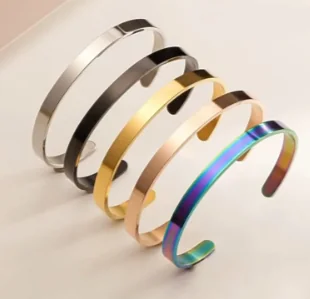
Walk through any jewelry workshop, and you will see two very different scenes. On one side, machines click and whir, cranking out identical links by the thousand. On the other, skilled fingers bend, connect, and close each bracelet one at a time. Both methods produce finished goods, but they serve different needs. A stainless steel bracelet manufacturer offering both options gives brands flexibility. The real question is not which method is “better” overall—it’s which one fits your order volume, design complexity, and quality expectations.
Speed and Consistency: Where Automation Wins
Automated assembly shines on high-volume runs of simple designs. Think 5,000 identical curb chain bracelets. A stainless steel bracelet manufacturer using automated link-forming machines can produce those in days, not weeks. Every link comes out exactly the same length and width because the machine follows programmed measurements. No human fatigue, no slight variations between Monday morning and Friday afternoon pieces. One production manager noted that automated lines achieve a defect rate under 0.5% for basic styles—impressive numbers. However, automation struggles with intricate weaves or bracelets that require directional links. Machines also have high setup costs, so small batches (under 500 pieces) become expensive per unit.
Detail and Adaptability: The Case for Hand Assembly
Hand assembly feels slower, but it handles complexity better. A skilled stainless steel bracelet manufacturer can weave intricate patterns like Byzantine or Figaro links that confuse even advanced machines. Hands also adapt instantly when a design changes mid-run—no reprogramming, no downtime. One jewelry brand requested a last-minute clasp swap from lobster to magnetic closure. The hand-assembly team made the switch in hours, while an automated line would have taken days to retool. Hand assembly also allows for real-time quality checks: the assembler feels a loose link immediately and fixes it on the spot. The trade-off? Slower output. A good hand assembler might complete 200 bracelets per day, while a machine does 2,000. For a stainless steel bracelet manufacturer, that means hand assembly works for premium, limited-edition, or highly custom orders.
Hybrid Approach: Using Both Methods Smartly
Many shops don’t pick one or the other. They use automation for repetitive base structures—like forming standard link chains—then switch to hand assembly for final connections, clasp attachments, and detail work. This hybrid method gives a stainless steel bracelet manufacturer the speed of machines with the flexibility of human touch. For example, a brand ordering 3,000 rope chain bracelets might have the chain links machine-made, then hand-assembled with custom charms or engravings. That balance keeps costs reasonable without sacrificing the unique details that define a brand’s identity. Buyers should ask potential suppliers: what percentage of your production is automated versus hand-assembled? The answer reveals a lot about their typical order profile and flexibility.
Neither automation nor hand assembly wins outright. High-volume basic designs lean toward machines. Low-volume intricate pieces demand hands. Many brands benefit from a hybrid that uses each method where it performs best. Star Harvest operates both automated and hand-assembly lines, allowing them to match the right process to each stainless steel bracelet manufacturer’s order—so brands get consistency where it matters and craftsmanship where it counts.
