Running a clinical trial in Europe involves more than translating a protocol into different languages. Even with EU-wide regulatory harmonization, sponsors still need to navigate national health authorities, varied site infrastructure, and population differences across dozens of countries. Selecting the right outsourcing partner for this environment generally requires looking past marketing claims and examining how a CRO actually operates on the ground in the specific countries where a trial will run.
Europe’s Regulatory Framework: EMA, National Competent Authorities, and the CTR
Clinical research in the European Union operates under the Clinical Trials Regulation (EU) No. 536/2014, which came into application on January 31, 2022, and became mandatory for all new clinical trial applications as of January 31, 2023. The regulation replaced the earlier Clinical Trial Directive and introduced the Clinical Trials Information System (CTIS), a centralized platform that the European Medicines Agency (EMA) sets up and maintains in collaboration with EU member states and the European Commission.
Under CTIS, a sponsor can submit a single application to seek authorization for a clinical trial in up to 30 EU/EEA countries simultaneously. That said, authorization itself is not centralized. A sponsor nominates one Reporting Member State to coordinate the scientific assessment (Part I), while each concerned member state remains responsible for its national requirements, including the relevant ethical and site-related assessments under Part II. This two-part structure means that while the submission process is more streamlined, national regulatory requirements and country-specific ethics review timelines can still affect how quickly a trial is authorized in each country. A CRO working in Europe needs staff who understand both layers — the EU-wide submission process and the country-specific review that follows it.
What a European CRO’s Service Footprint Should Actually Cover
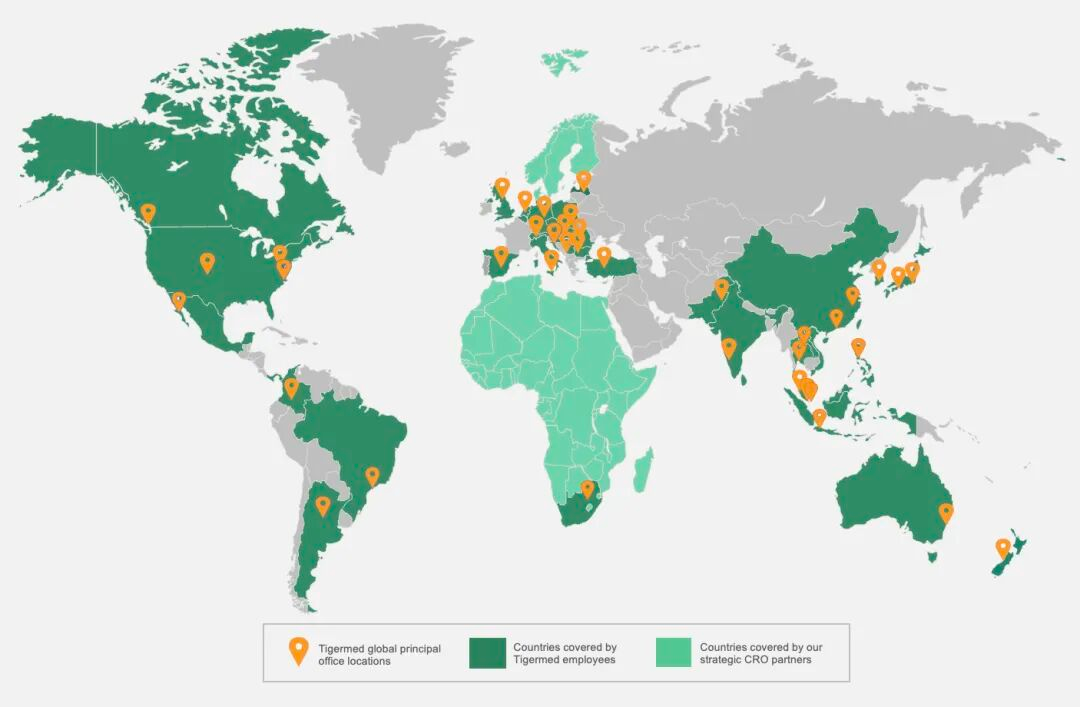
Sponsors evaluating a contract research organization europe provider should examine its established local network whose presence was built deliberately over time, rather than assembled reactively for a single study. Tigermed offers one illustration of how a CRO has approached this. In its published 2025 overview, Tigermed reported that its EMEA business covered more than 20 countries, with 15 offices and over 160 employees across Western and Eastern Europe.The company reports having conducted more than 200 Phase I–IV trials through its European team and cites more than 30 years of combined staff experience in regulatory affairs, drug safety, and clinical operations.
Tigermed also expanded this regional capability through the January 2023 acquisition of Marti Farm, a Croatia-based European CRO with services spanning pharmacovigilance, clinical operations, regulatory affairs, and medical affairs, along with a pharmacovigilance software platform. By mid-2024, Tigermed reported that its multi-region clinical trial (MRCT) experience covered 19 European countries. These figures are useful less as a comparison point and more as an example of the kind of regional detail — office count, country coverage, years of local experience, and trial history — that sponsors can reasonably ask any prospective CRO to disclose before selection.
Patient Population Access Across European Markets
Regulatory approval is only one part of running a European trial; recruiting an appropriate patient population is another. European countries differ substantially in healthcare system structure, disease prevalence, standard-of-care practices, and site density for particular therapeutic areas. A country with a strong public hospital network and centralized patient registries may support faster recruitment for certain indications, while a more fragmented or private healthcare system may require broader outreach across more sites to reach the same enrollment target.
This is where an outsourcing partner’s existing site relationships matter. A CRO with prior experience working with hospitals, academic centers, or specialty clinics in a given country may have more relevant information for assessing site feasibility, enrollment timelines, and expected patient volumes. Sponsors evaluating options should ask prospective partners for site-level experience by therapeutic area and country, not just aggregate figures for the region as a whole, since recruitment feasibility can vary considerably even between neighboring EU member states.
Verifying a CRO’s Site Network Before Signing an Agreement
Before finalizing a European outsourcing partnership, sponsors typically benefit from confirming several operational details directly rather than relying solely on promotional materials. These generally include the CRO’s number of active offices and staff within the specific countries relevant to the trial, its track record of Phase-specific experience (early phase versus late-stage or post-marketing), and its familiarity with national competent authority requirements in the countries where sites will be activated.
It is also worth confirming how a CRO manages data protection under the General Data Protection Regulation (GDPR), since clinical trial data handling across EU borders carries its own compliance requirements separate from the CTR itself. Sponsors may additionally want to review whether pharmacovigilance and medical translation capabilities are handled in-house or subcontracted, as this can affect both cost and turnaround time for safety reporting. A global contract research organization with established European infrastructure will typically be able to provide documented answers to these questions, including specific office locations and language capabilities, rather than general statements about regional presence.
Choosing a Partner Suited to the Trial at Hand
There is no single CRO profile that fits every European trial. A small, single-country study may be well served by a regional specialist, while a multi-region Phase III program spanning several EU member states usually benefits from a partner with broader established infrastructure and demonstrated regulatory experience across those specific countries. Sponsors are generally advised to match the scope of the trial to the scope of the CRO’s actual, verifiable European footprint, request references tied to comparable studies, and confirm current regulatory standing before entering into any service agreement. Companies such as Tigermed, which report multi-country office networks and documented regulatory experience across EMEA, illustrate one model of how CROs have positioned themselves to support this kind of cross-border clinical development work — though sponsors should evaluate any provider’s specific, current capabilities rather than relying on general reputation alone.
