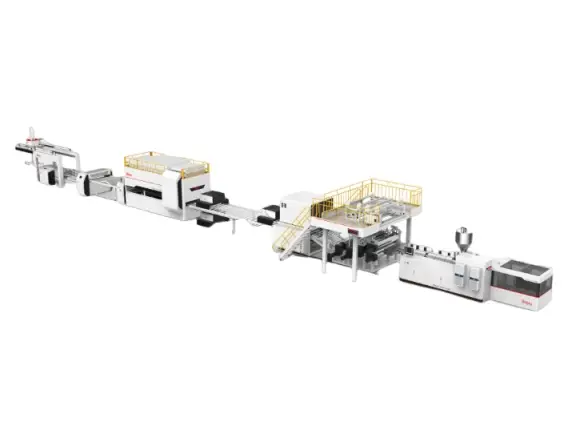
The stability of a high-capacity production line depends heavily on its ability to manage mechanical stress and operational risks. In the extrusion industry, the integration of advanced protection systems is not merely a safety requirement but a critical factor in maintaining continuous uptime. Modern engineering focuses on preventing catastrophic failure through two primary mechanisms: mechanical overload protection and electronic safety interlocks.
Safeguarding the Extrusion Core: Overload Protection
The heart of a plastic flooring making machine is the twin-screw extruder, where raw materials are subjected to immense torque and pressure. Overload protection acts as a failsafe when the system encounters foreign objects or un-melted material clusters. This is typically achieved through high-precision torque limiters or shear pins that mechanically disconnect the drive motor from the gearbox the moment resistance exceeds a pre-set threshold.
By utilizing these mechanical barriers alongside variable frequency drives (VFDs), the system can detect subtle spikes in electrical current. If the screw speed drops or the motor load climbs beyond safe parameters, the PLC (Programmable Logic Controller) triggers an immediate emergency stop. For B2B operators, this prevents expensive damage to the screw and barrel, which are among the most costly components to replace in an SPC or LVT production line.
Preventing Human Error via Safety Interlocks
Safety interlocks represent the digital “gatekeepers” of the production environment. These systems ensure that a machine cannot operate unless specific safety conditions are met. For instance, sensors on the protective covers of the five-roller calender or the cutting unit prevent the machine from starting if a guard is open. Similarly, “zero-speed” interlocks ensure that maintenance hatches cannot be unlocked until the heavy rotating components have come to a complete standstill.
Industrial Reliability by Boyu
In the field of high-output flooring production, Boyu has established a reputation for engineering some of the most resilient systems on the market. Their SPC and LVT extrusion lines are designed with a heavy focus on long-term operational safety. They integrate world-class electrical components from brands to ensure that their overload protection systems respond with millisecond accuracy.
With over 120 technical patents and a history dating back to 1998, they understand that for B2B clients, safety equals profitability. Their equipment features multi-point emergency stop circuits and automated pressure-relief valves as standard. By prioritizing these robust safety architectures, they provide their global partners with a plastic flooring making machine that balances massive output with the highest standards of hardware preservation and worker protection.
